

AmblyoPunch
Train Your Brain. Strengthen Your Vision. Beyond the Patch.
About
AmblyoPunch is a specialized Meta Quest VR application developed by Seven Sportz to provide a modern, engaging way to practice visual skills for amblyopia (lazy eye). While traditional patching and clinical vision exercises can feel like a chore, effective training should be interactive and accessible.
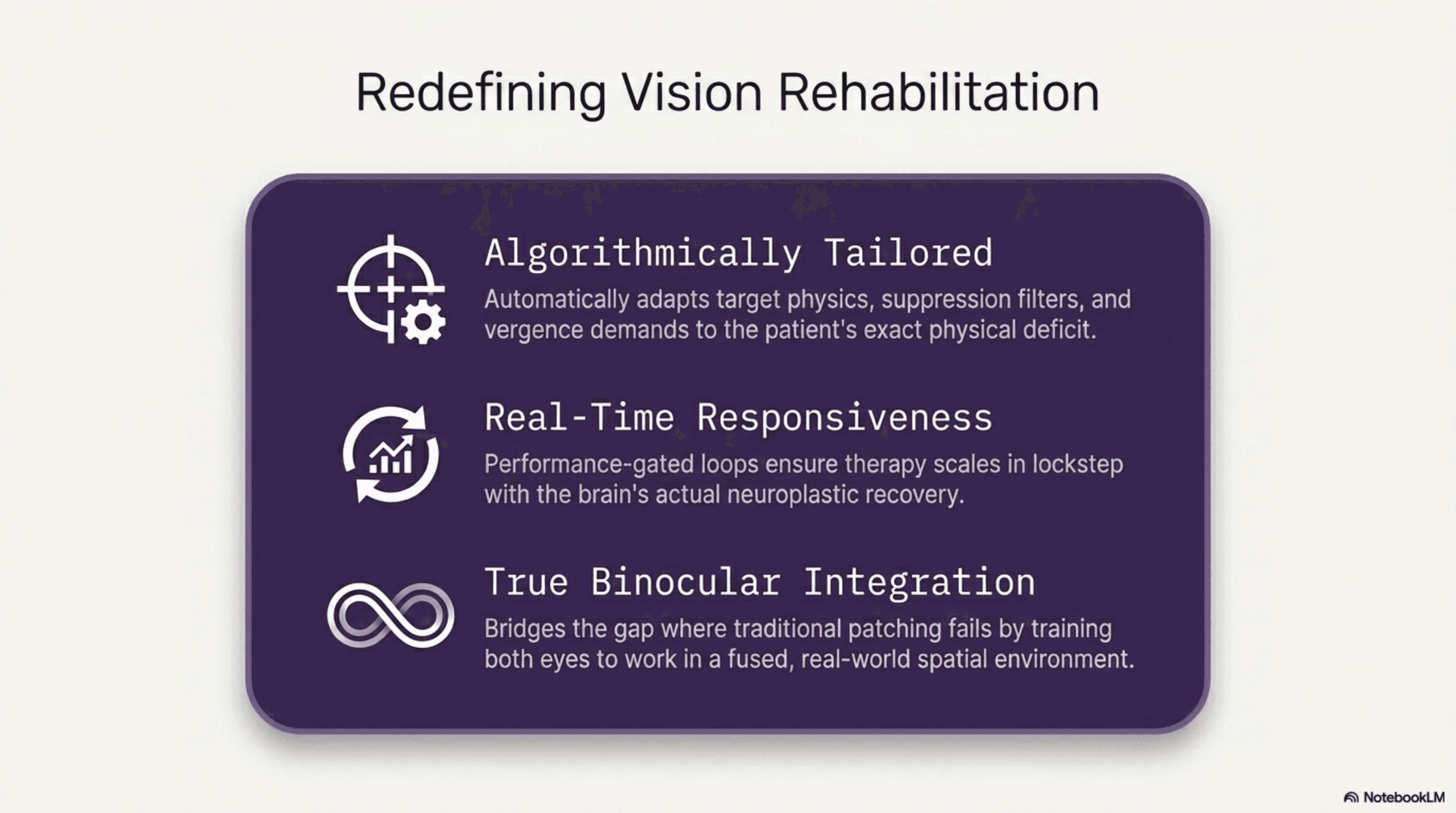
We aim to solve the "patching problem". Traditional patching isolates the weak eye, but as soon as the patch is removed, the dominant eye often takes precedence again. Our vision is to use Virtual Reality to teach both eyes to work together in a synchronized way.
How it works
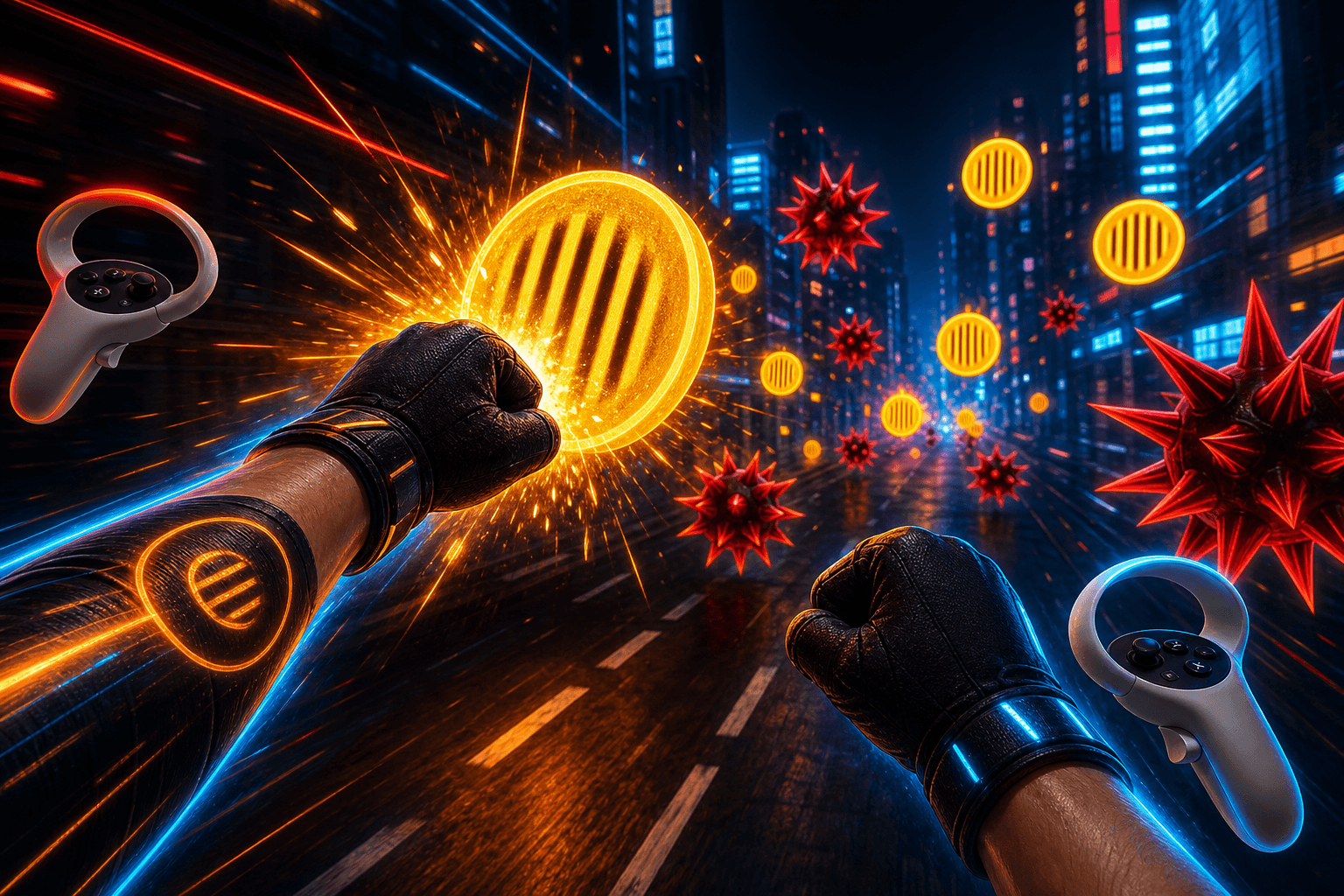
- ▸Immersive gameplay: enter a virtual city, punch Gabor-pattern coins for points, dodge red spikes.
- ▸Hand-eye coordination: reach out with controllers or use natural hand-tracking.
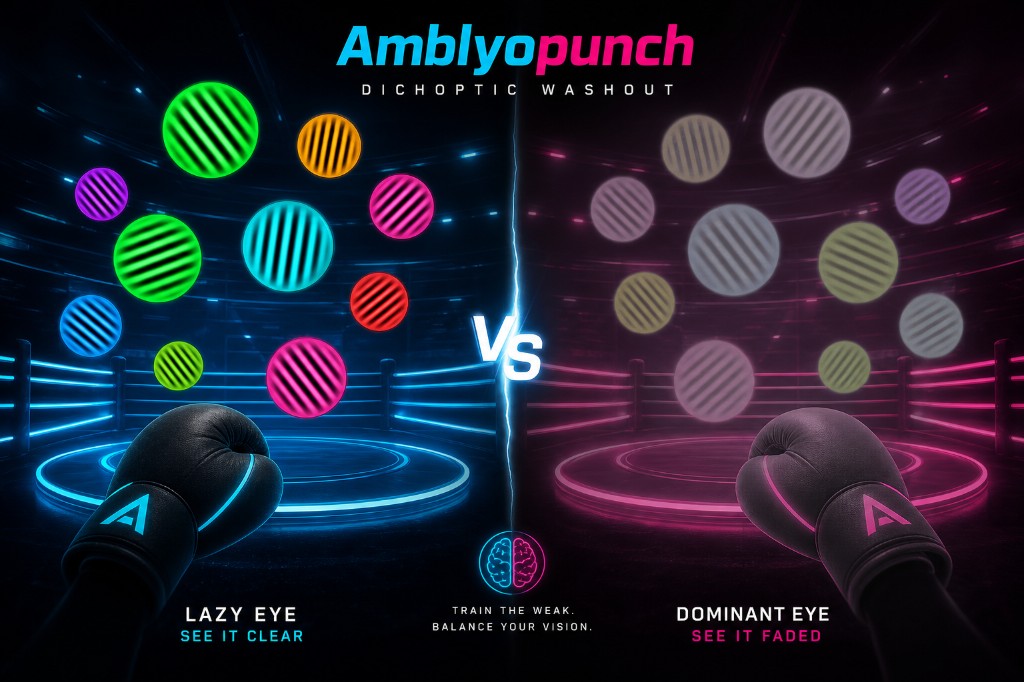
- ▸Training precision: visual filters dim and wash out the dominant eye to rebalance input.
Product explainer videos
AmblyoPunch trailer
Official trailer — VR vision therapy gameplay on Meta Quest.
AmblyoPunch — VR game to train lazy eyes
Gameplay overview: punch Gabor-pattern targets in a virtual city, dodge obstacles, and practice lazy-eye training on Meta Quest.
AmblyoPunch menus
Walkthrough of in-app menus, settings, and navigation.
AmblyoPunch menus (extended)
Additional menu and setup walkthrough for severity, eye selection, and session options.
Browse the full AmblyoPunch playlist — trailers, gameplay, and menu walkthroughs.
Vision Check
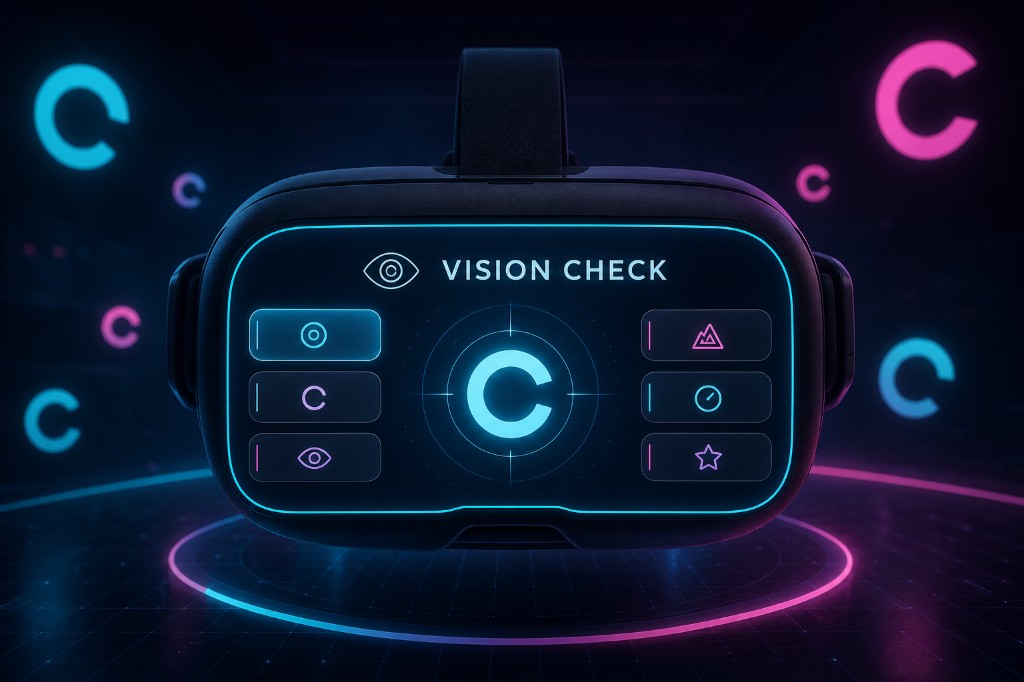
Before your first session, AmblyoPunch runs a built-in Vision Check — an in-app visual-acuity test that measures how well each eye sees, classifies your amblyopia as Mild, Moderate, or Severe, and automatically personalizes every therapy session to your results. Every person’s vision is different, so instead of giving every player the same experience, the app builds a therapy program that matches your current vision level.
AmblyoPunch Lazy Eye Vision Check
See the Vision Check in action: Landolt C rings, per-eye testing, and automatic severity classification.
AmblyoPunch Vision Check manual
Step-by-step manual for completing the Vision Check accurately and entering results from your optometrist.
How the test works
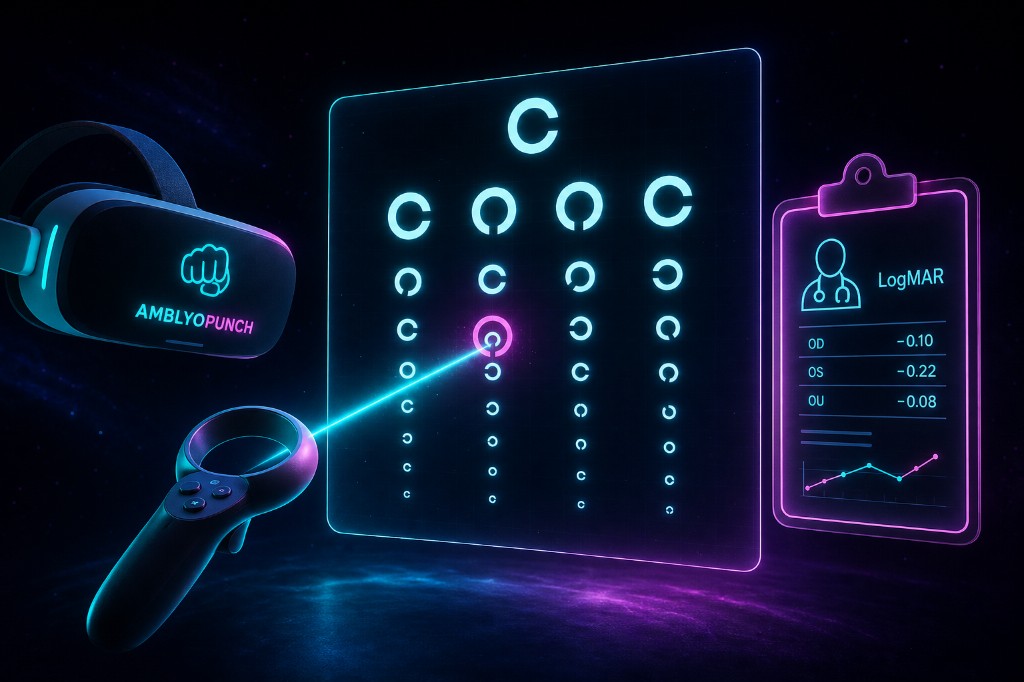
After selecting which eye is your lazy eye, the check runs in three stages: first your lazy eye alone, then your dominant eye alone, then both eyes together. In each stage you are shown Landolt C rings — small rings with an opening facing a different direction — and you simply pick the direction of the opening. The rings change size to find the smallest detail each eye can reliably resolve. Each stage takes about 30 trials; if a ring is genuinely too small or blurry to read, choose “Not Visible” instead of guessing.
Your severity classification
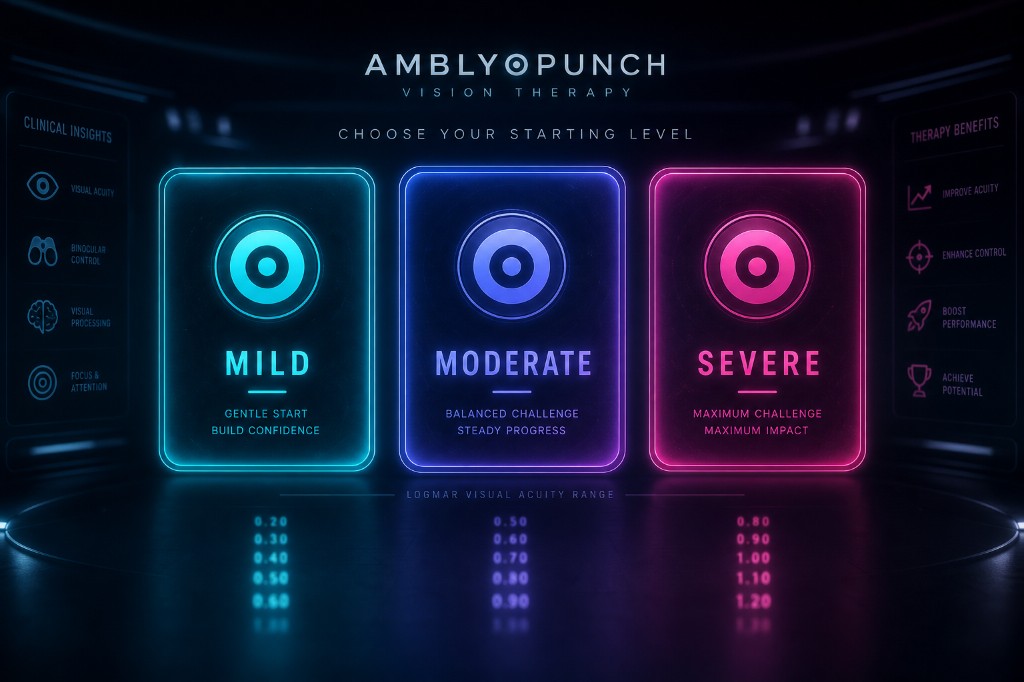
Results are scored on the LogMAR scale using your weaker eye while wearing your prescribed glasses. Your overall level is set by your worst-performing eye, not the average — if your lazy eye scores 0.6 and your dominant eye 0.2, your condition is classified as Severe, so therapy focuses on the eye that needs the most work.
Mild
LogMAR ≈ 0.3
The weaker eye sees relatively well and can join binocular therapy with minimal assistance.
Moderate
LogMAR 0.3–0.5
The weaker eye needs extra support, so therapy mixes monocular and binocular exercises.
Severe
LogMAR 0.6+
The weaker eye needs extensive strengthening first, so therapy leans heavily on monocular training.
How your results shape gameplay
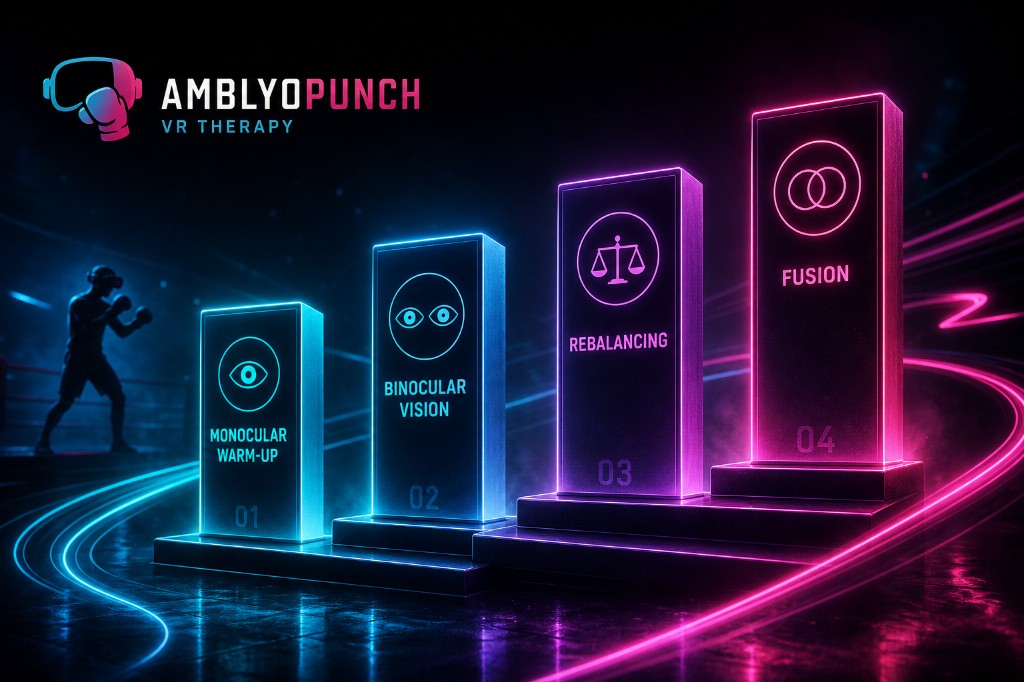
The Vision Check result drives the adaptive therapy system across all four training stages. With Severe vision, coins and obstacles appear almost exclusively to the lazy eye (monocular warm-up) to build strength first. With Moderate vision, both eyes see the game but the dominant eye’s view is noticeably faded, so the weaker eye does more of the visual work. With Mild vision, both eyes participate actively with only light fading, and therapy focuses on binocular coordination and fusion. As you improve, the fading rebalances until both eyes contribute equally, then fusion training teaches the brain to merge both images into one clear picture — improving eye coordination and depth perception.
Can you skip the test?
Already know your LogMAR acuity from your eye doctor? You can skip the in-app test and enter your values for the left eye, right eye, and both eyes together — the app classifies your condition from the worst eye, just like the built-in check.
Tips for accurate results
- ▸Wear your prescribed glasses if you normally use them.
- ▸Test in a well-lit room and don’t rush the ~30 trials per stage.
- ▸Choose “Not Visible” instead of guessing when you truly can’t see the opening.
- ▸Retake the check over time to track progress — your therapy profile updates automatically.
Why Gabor coins train the eyes
Every target you punch is a Gabor coin — not a generic graphic, but a structured visual stimulus built from oriented stripes inside a soft-edged patch. In vision science, Gabor patterns are used to probe how the brain detects contrast, orientation, and fine detail. AmblyoPunch turns that principle into gameplay: locating, tracking, and striking these coins forces the visual system to work harder than it would with plain shapes or text.
Contrast and detail the lazy eye must resolve
Amblyopic eyes often struggle with low-contrast and finely structured images. Each Gabor coin presents a clear orientation and spatial-frequency pattern the brain must pick out against the city backdrop — exercising the same pathways that weaken when the dominant eye takes over.
Visual-cortex activation through target acquisition
Punching a coin is deliberate target acquisition: your brain locates the pattern in depth, plans the reach, and times the hit. That loop stimulates visual-cortex processing while room-scale movement adds spatial awareness — the same combination the training design calls “punch to stimulate, dodge to trigger spatial awareness.”
The coin evolves with each training stage
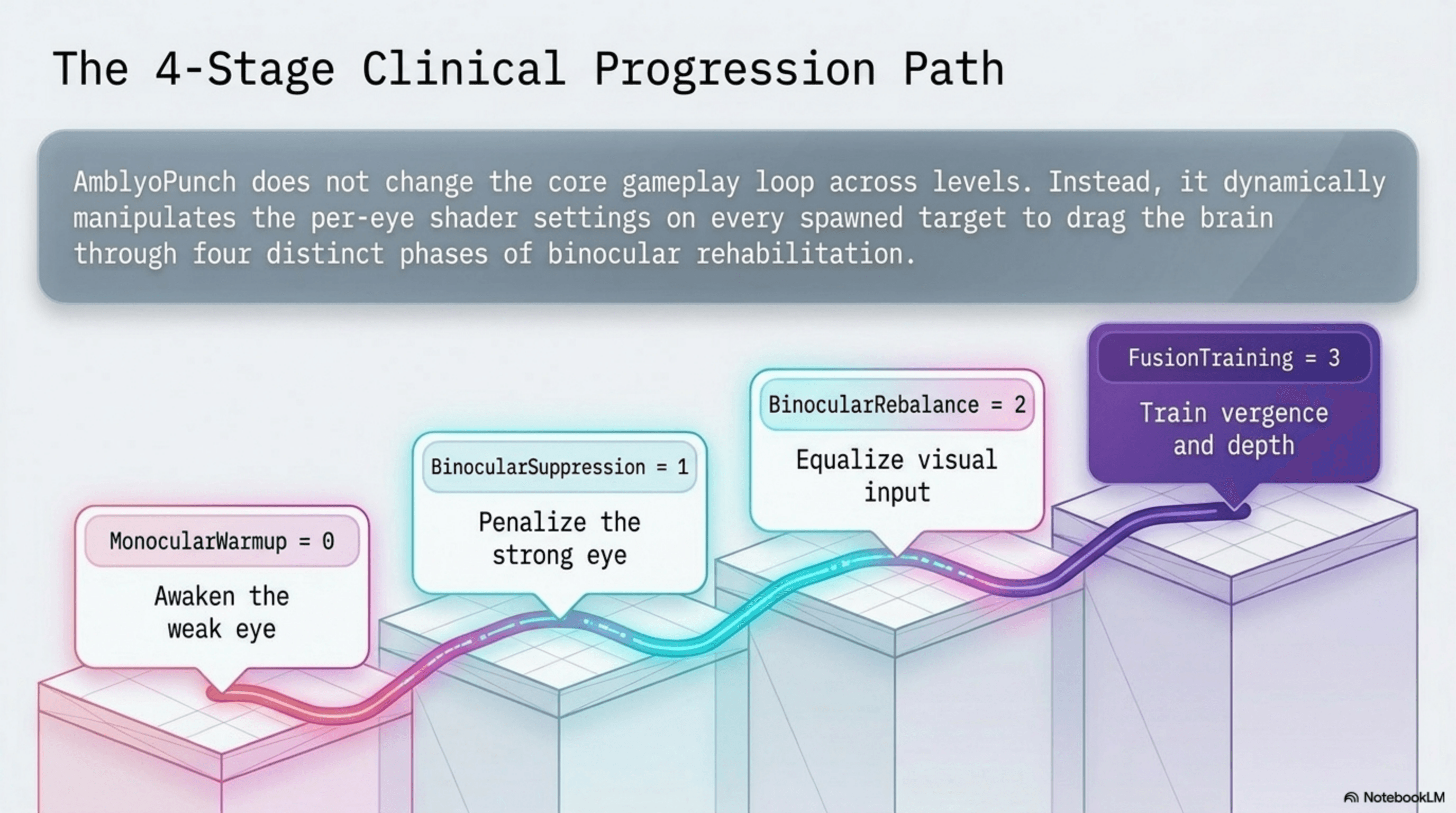
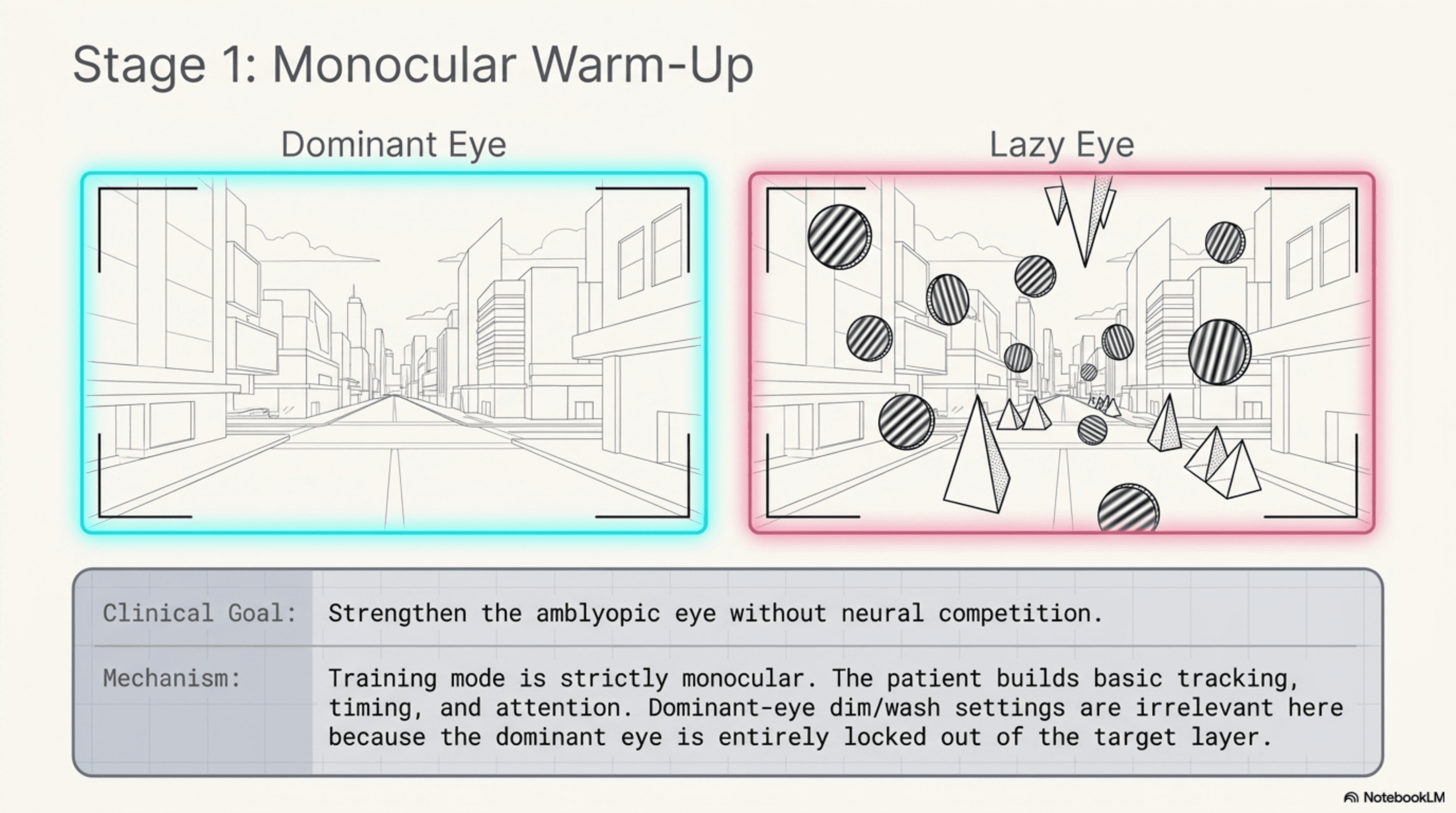
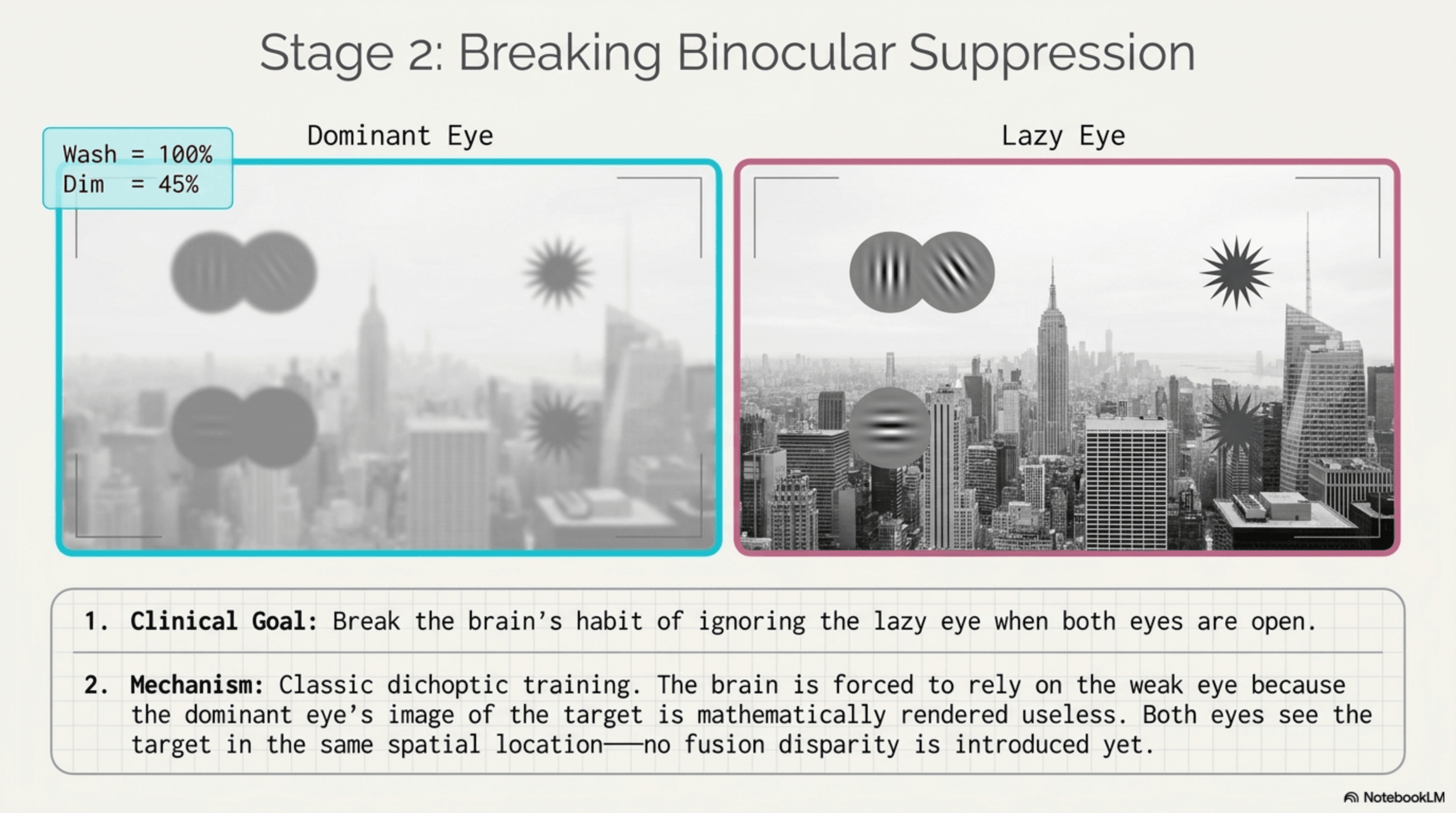
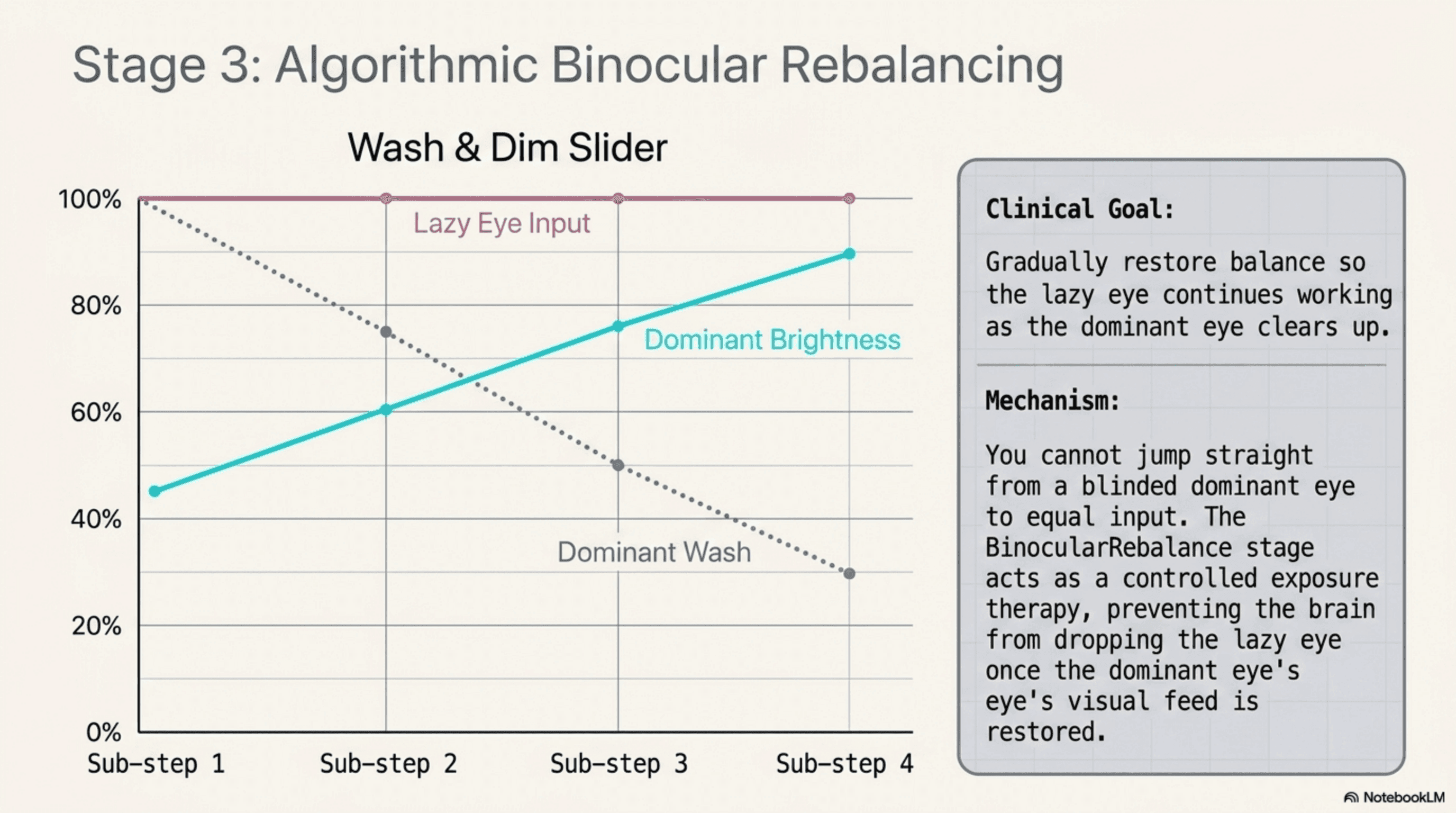
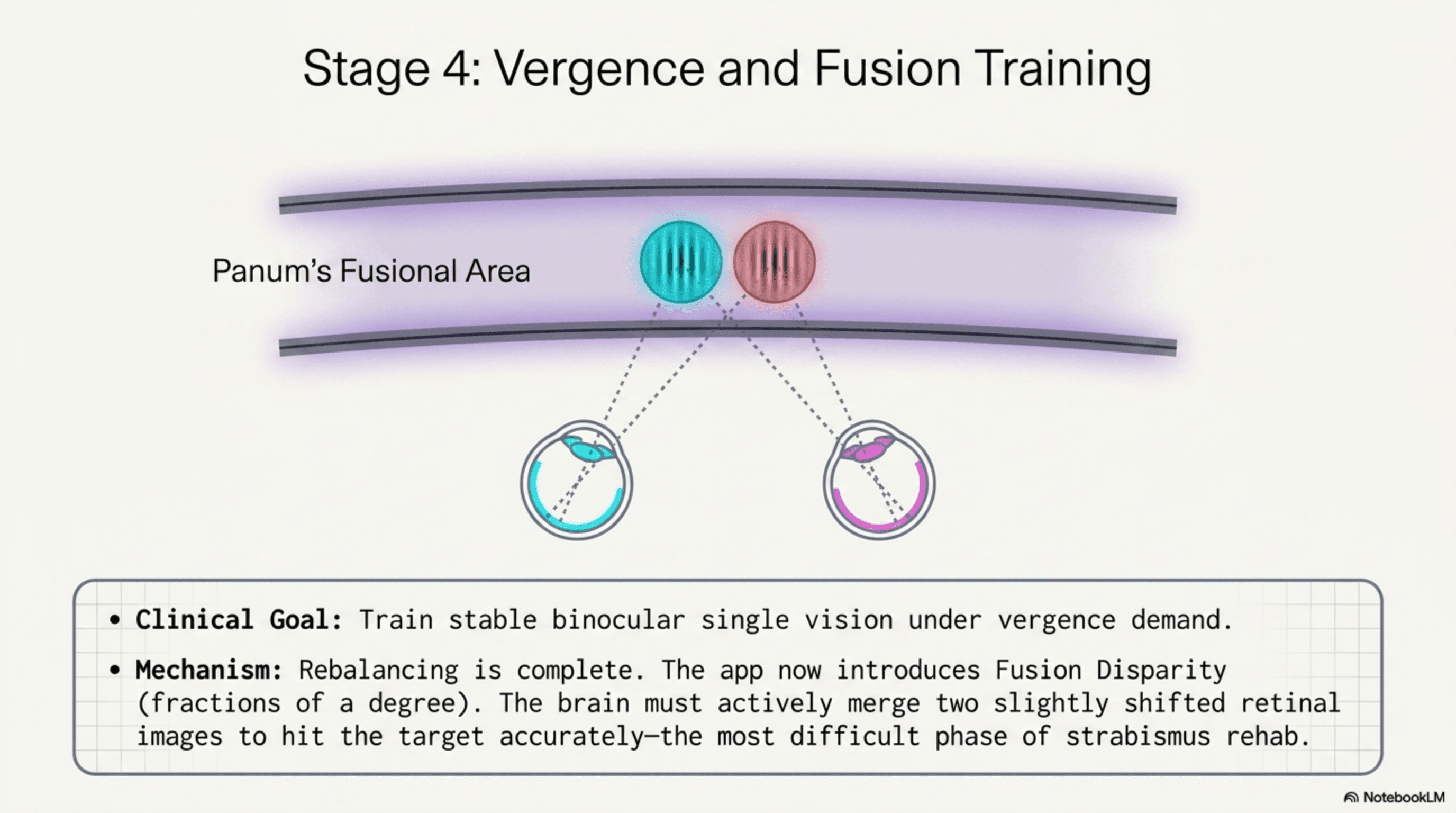
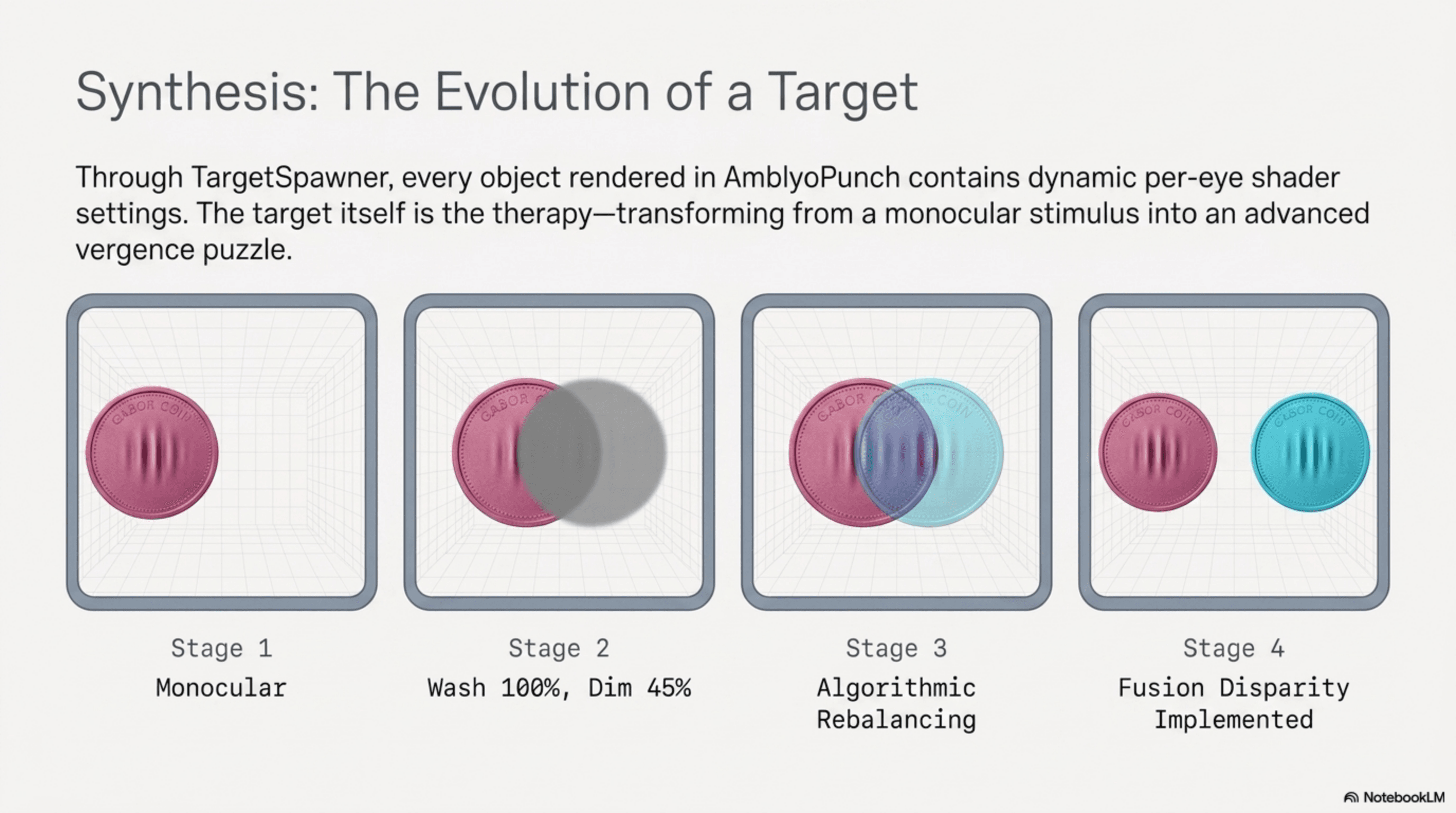
The gameplay stays the same, but what each eye sees on every Gabor coin changes. Stage 1 shows coins only to the lazy eye. Stage 2 washes out the dominant eye’s view of the same coin. Stage 3 gradually restores balance. Stage 4 introduces fusion disparity so both eyes must merge slightly different views to hit the target. The coin is the therapy.
Difficulty scales with your performance
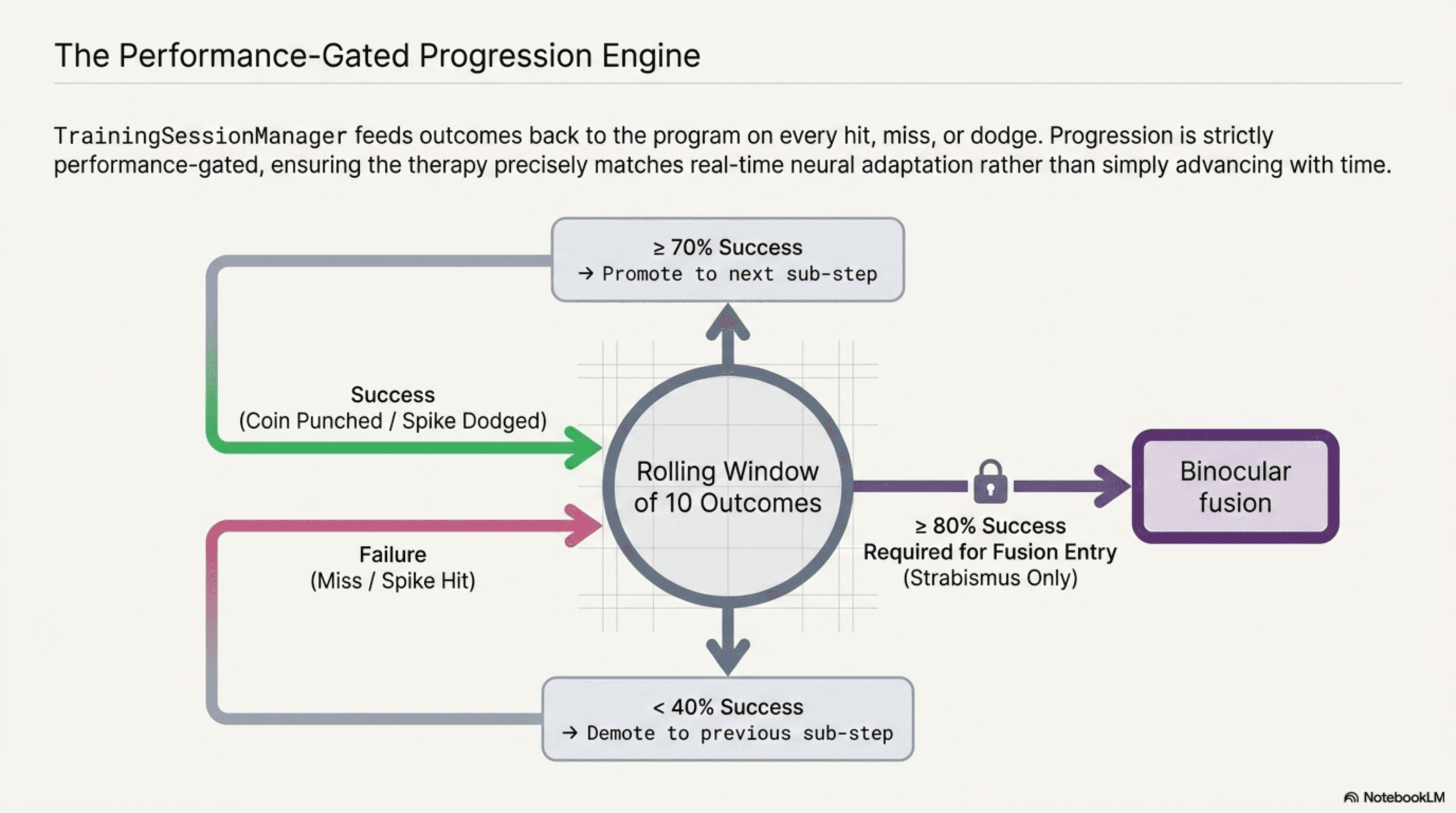
Target size, speed, and suppression filters adapt to your severity profile and success rate. As you improve, coins become smaller and faster — keeping the Gabor pattern at the edge of what your eyes can reliably detect, which pushes neuroplastic recovery without manual guesswork.
The 4-stage training journey
Stage 1: Lazy Eye Warm-Up
Monocular — targets visible only to the lazy eye to build tracking and attention.
Stage 2: Breaking Suppression
Binocular — dominant eye heavily dimmed; brain favors lazy-eye input.
Stage 3: Rebalancing Eyes
Gradually restore clarity to the dominant eye until both contribute equally.
Stage 4: Fusion Training
Fusion disparity trains the brain to merge images using Panum's fusion area.
Personalized to your eyes
- • Select your lazy eye (left or right).
- • Severity: Mild, Moderate, or Severe — adjusts target size, speed, and stage length.
- • Strabismus: Esotropia or Exotropia settings for fusion training.
- • Automatic mode: 70% success rate to advance (80% for strabismus); demotion below 40% to avoid diplopia.
Training guide
Ready to start?
Experience the boost in your visual system — scores and vision improve over time.
Get on Meta QuestNot a medical device. Consult an eye care professional for clinical guidance.